Posts

Everything they taught you was wrong

"Everything they taught you was wrong"... A biochemist said that to me recently: entering upon a PhD, remembering what had been said when she embarked upon A level, degree, MSc, PhD.... At each stage the new teacher, lecturer, tutor, supervisor .... everything they taught you was wrong, now we start to learn what is right. We are all familiar with it - at various stages in our education, someone takes apparent delight in disillusioning us - everything we learnt is wrong, so we have to start again. But the thing is, it wasn't wrong. When we learn something - anything that is at all complex - we have to simplify it. Almost everything worth learning is unutterably complex - complicated almost or actually beyond understanding. So what we do is, to learn an aspect of it. 'Aspect' is a visual term - it describes the way you look at something: the view you take of it, how it looks from a given viewpoint. Take a house for example, Not much more familiar, nor m...
Apathy Soc

When I was an undergraduate at University, I enjoyed going to Student Union debates. They were interesting, often passionate, debates - sometimes discussions, often arguments. Much of what was debated directly affected us students and the University - I recall one heated debate over whether the Union should promote the idea - revolutionary in the 1970s - of a coffee bar: the notion that student social life then might revolve around something other than cheap alcohol was actually quite new, and strange as it may now seem coffee shops were then rare. That was the main stuff of the Union, really - how best to direct limited funds to support student societies ('Socs', they were called); what to request from the University in terms of student welfare; how to encourage better teaching; what amenities should be provided on campus. Some debates were wider - issues over which we had no real influence whatsoever - the future of nuclear power, of nuclear weapons, what we should ...

The Mysterious Secret of Successfully Growing Houseplants

I am, without boasting, good at growing house plants. I wasn't always. House plants used to die and wither for me, just as they do for most people. But then I discovered the mysterious secret of looking after house plants. My house plants now flourish: they grow glossy healthy leaves, they flower, and they propagate. I give them away for Mothers' Day and at Christmas and at birthdays. I have African Violets that are the sixth generation of propagation from plants bought for £1 at the supermarket. I have Peace Lilies a metre high, grown from off-shoots of plants three years ago. Here, I will let you into the mysterious secret of successfully growing house plants. Every day, I check the plant's soil. If it is dry, I water it: if not, I don't. That's it. Every day. Every single day. That's it. The mysterious secret of looking after house plants. Look after them. That's it.

Walls

Walls are in the news right now: physical walls as well as metaphorical ones - designed to keep people out from where they want to be. In running we talk about The Wall - hitting the wall. It refers to the time in a long run where you can't go on - a step change in your physical and mental condition that is so great that you risk being unable to continue at all. They call it hitting the wall because that is what it is like - sudden, painful, and insurmountable. Of course many runners do surmount the wall - but it vividly captures the change of state between  being OK and being decidedly not OK. I have been lucky in that I haven't actually hit the wall - perhaps because I am so slow, I sort of stumble into it. So rather than hit the wall hard and bounce off, slumping to the ground injured and defeated, I tend to sort of tumble awkwardly over it. So I have got off lightly - so far - with hitting the wall. But still for me it represents that step change - an abrupt, surprising...

The facts of life

"Facts are sacred" Well, no - sacred things are sacred: facts are just facts. But I think the quote is trying to say that facts are true, which is different from sacred - except in the sense that one can use 'sacred' to mean 'inviolable', or 'unquestionable' - or 'matters of faith". A short talk by James at Woking's Cafe Scientific: https://www.facebook.com/events/1559113751055062/ and an animated discussion that preceded it, reminded me of a statement that is commonly made but that I suspect is not so. In a discussion, one participant may say that something they are asserting is a 'fact' - and that should end the argument, because facts are unquestionable. Except they are not. And I don't mean just in the sense that people sometimes use, where they imply that the person questioning their fact is doing so only in some deluded counter-factual sense. In fact (sic) I would suggest that facts are inherently ques...

Slow Driving

Sarah can be a bit literal at times. Today I drove the  grandchildren to school, and on my return what seemed like hours later I remarked that we could have walked in the time it took me to drive. Sarah of course - and quite correctly - contradicted me. Sometimes Sarah does not permit hyperbole. However, I was motivated to check. And she was right. But there is more to it. When you drive, you have to go a more circuitous route - 3 miles in total, each way. In today's traffic, that took me about 20 minutes each way. To walk, I would have followed the towpath along the canal most of the way - 2 miles, so only two thirds of the distance. At my regular walking pace of 12 minutes per km (20 minutes per mile) that would have taken me 40 minutes each way - twice as long as the car journey. With the grandchildren, walking slower, diverting off to points of interest, and probably stopping occasionally to complain of various ephemeral aches and pains and reasons why they could not walk...

How to confuse people

Image
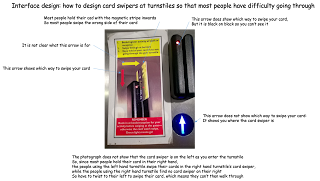
At Woking Leisure Centre, people are often stopped by the turnstiles where you have to swipe your membership card. Some years ago Sarah and I wrote and presented a paper on interface design: "Profiling API usability for consumer electronics software" Its theme, as is so much that I write, was quite simple: that an interface could be judged (quantitatively, in that paper) based on simple measures of how much effort you had to put into using it. (An API is an Application Program Interface - a defined way in which software is to be structured and used.) Interestingly, on checking our paper on interface design before writing this blog, I see it has been much cited in later work, which is gratifying. We based our work on observations from Microsoft, who put a lot of effort into designing interfaces for programmers using their programming tools. That work - and ours that leveraged it - was in turn based on psychology: specifically the psychology of Cognitive Dimensions,...